
Possibility - The Course of Life. 500 Kilometers Through the Atacama Desert
Investment Banking by Day, Ultra Runner by Night
Nicki Lange’s daily life is just as intense as the races he’s preparing for. “My workday is just as dynamic and unpredictable as an ultramarathon race,” he says. The day starts early: he gets up between 5 and 6 a.m. His first priority is recovery—mobility and stretching exercises on a foam roller to release the previous day’s tension from his body. After that, it’s time for his first workout: running, cycling, or a trip to the gym. By 9 a.m. at the latest, his workday begins in the high-pressure environment of investment banking. Nicki has a clear routine: In the morning, he focuses on the most intensive, cognitively demanding topics. After lunch, he has calls with investors and clients to analyze new investment opportunities. If time allows, another workout session is on the agenda in the evening. “I try to be in bed by midnight at the latest,” says Nicki—after one last restorative session on the yoga mat or in his COMPRESSION BOOTS, depending on what the day has demanded.


Passion, Not Duty
Her passion for running dominates her daily life, even if that means putting her personal life on the back burner. The strain is enormous, especially when preparing for extreme races like the one in the Atacama Desert. But for Nicki, one thing is clear: “At the end of the day, I enjoy doing this because running is a huge passion for me and means the world to me.”
Kilometers for the Mind—Long-Distance Runs on the Weekend
His training strategy focuses not on speed, but on endurance. “For me, it’s about covering a lot of distance—many kilometers—at a low heart rate and slow pace.” He deliberately schedules his long runs—often four to five hours—for the weekend. Sometimes he runs on Friday evenings well into the night. He uses these sessions not only for physical exertion but also as a way to mentally unwind from the stress of everyday life.


Recovery—the Underestimated Key to Success
As his experience grows, so does his awareness of the importance of rest. “I notice from year to year that I need more time to recover,” Nicki admits. Recovery isn’t an optional part of his training, but an essential component for staying strong both physically and mentally—at work and in sports. His life is a constant balancing act between high performance and recovery—driven by a deep passion for both.
Endless kilometers through the Atacama Desert—Nicki’s source of mental strength and his anchor in extreme situations
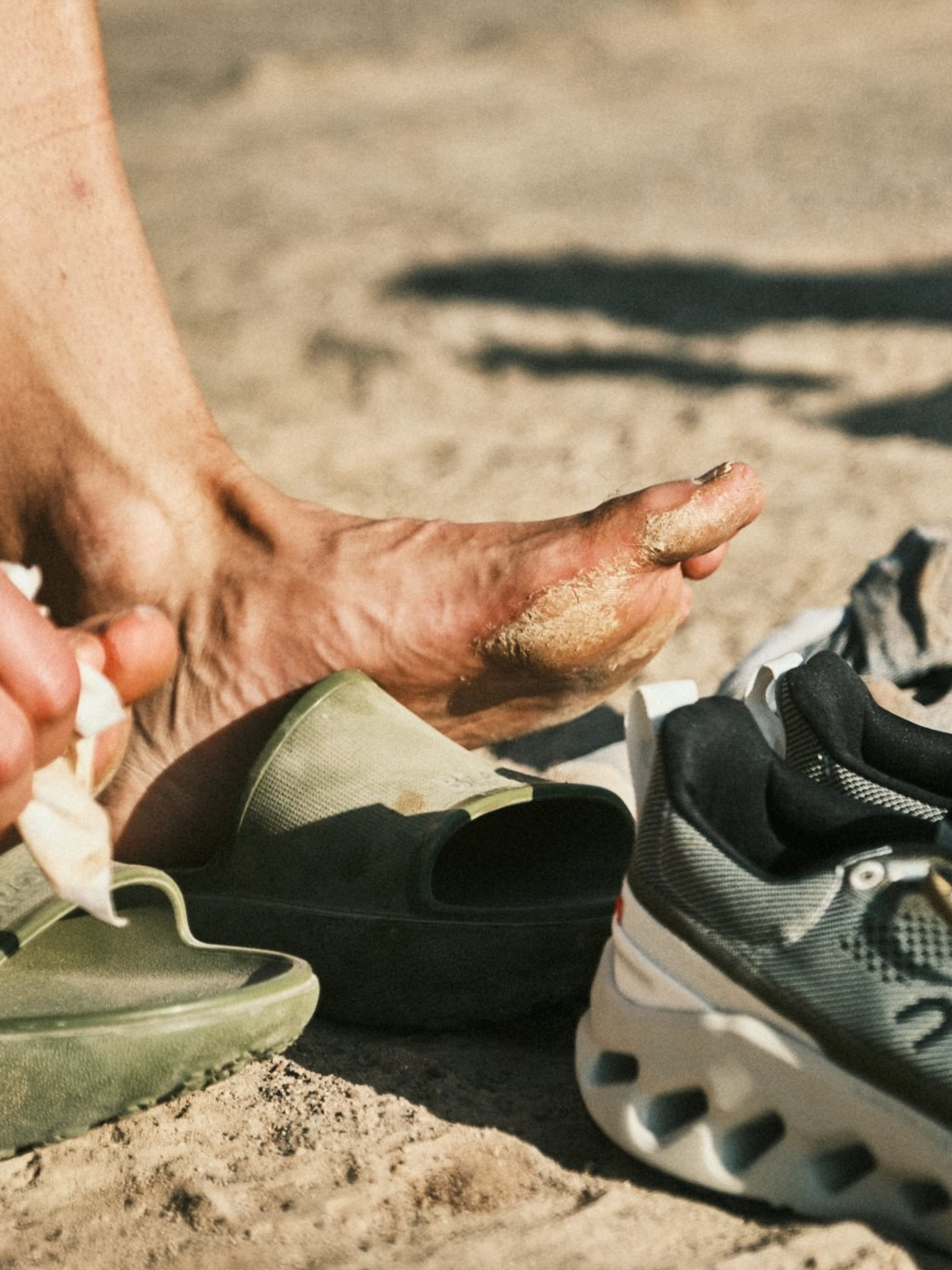
During his run, Nicki was never completely alone—and yet he was left to his own devices. Depending on the section of the route, his support team would drive a few kilometers ahead and wait for him. In more dangerous sections, such as in villages with stray dogs, “the car drove right alongside me,” he says. Always by his side: Johannes and Erik, the photo and video team, and Agi as all-around support. Sometimes they even ran alongside him—not just as a safety measure, but also as mental support: “So I could talk a little and take my mind off things.”
Even when he was deep inside the tunnel, this brief contact with the outside world helped. Still, he always remained focused: “You try to conserve every bit of energy—even thinking takes energy.”
Spanish Soliloquies
A very special anchor that Nicki has discovered for himself during his extreme adventures is the dialogue he has with himself—in Spanish. This unusual technique developed during his runs from Los Angeles to Las Vegas and at the legendary UTMB (Ultra-Trail du Mont-Blanc): “I actually talk to myself in Spanish, which I’ve also learned, and then adopt a sort of third-person perspective.” This inner voice, this second persona that accompanies him, has become a kind of mental companion for him—a fixed ritual that carries him through the toughest kilometers.

Mental Mantra: What if – Why not?
Another key element of his mental strength is a motto that has stayed with him ever since a formative encounter on the other side of the world:
“What if – why not?”
For Nicki, this is more than just a catchphrase—it’s a philosophy of life. “We all tend to dwell on potential problems that might arise when facing challenges. But what if you just go for it?” he asks. His answer is clear: “What if I respond to ‘What if’ with ‘Why not’?” This shift in perspective—from overthinking to taking action—has changed everything for him.
“For me, there’s no ‘what if’—only ‘why not?’”
With this mindset, Nicki overcomes not only extreme distances but also mental hurdles. His Atacama run is thus not just a test of physical limits—but also a profound, personal adventure filled with mental strength, inner dialogue, and the power to surpass one’s own limits.
Recovery as a Daily Ritual on Every Stage
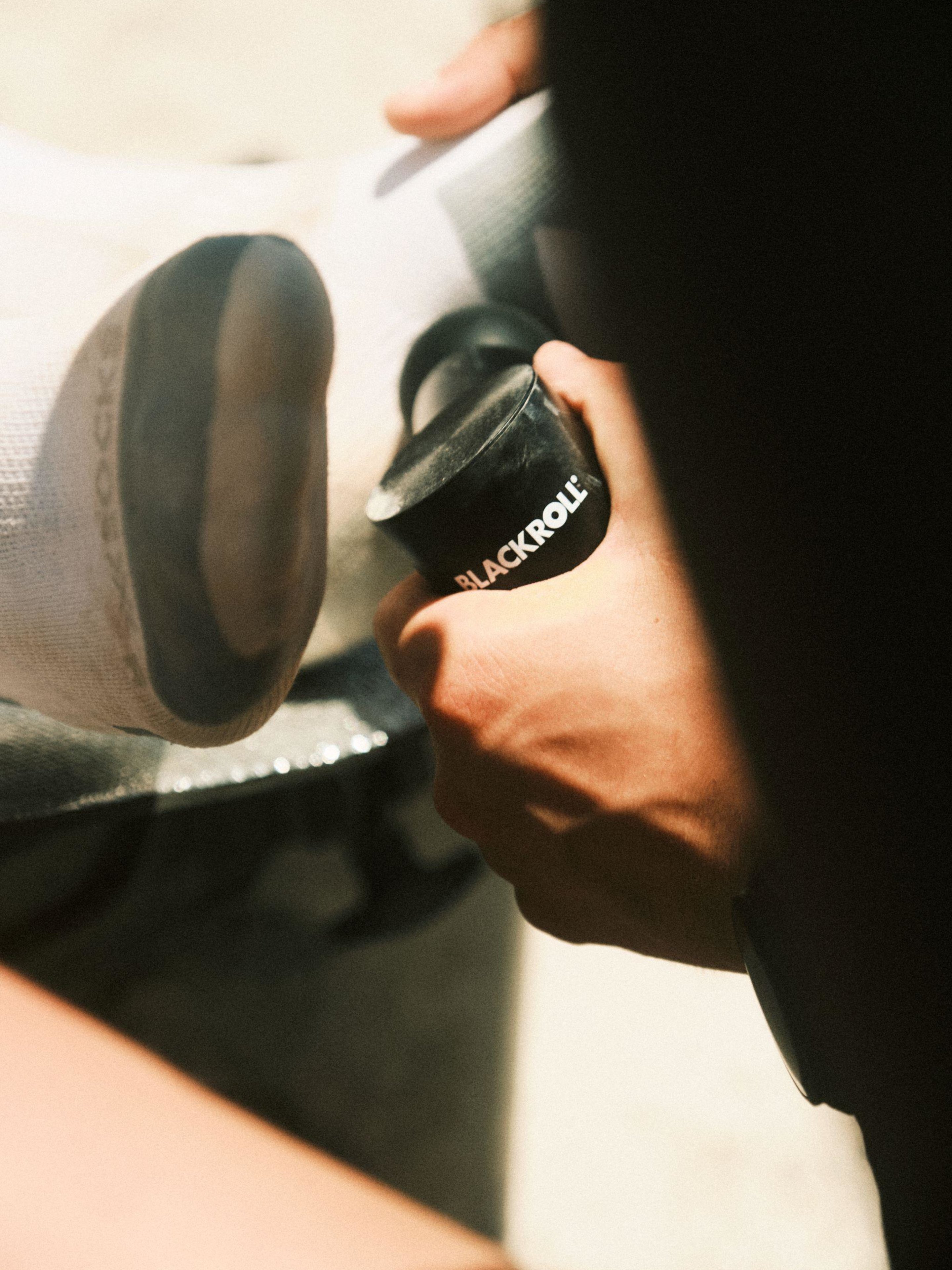
During his extreme runs, recovery was the key to his performance—a must and firmly integrated into Nicki’s daily routine. BLACKROLL products helped him achieve new personal bests every day. One tool in particular was his top priority: “The most important thing for me was the COMPRESSION BOOTS —I used them in the morning, at noon during my run, and in the evening. They were a huge help.” The boots helped him above all to massage lactate out of his muscles and loosen up his legs again for the next stage. Especially in the later phases of the run, as the strain increased, they were indispensable for him: “Toward the end, it got a bit tougher—that’s when the COMPRESSION BOOTS were a crucial piece of the puzzle for my recovery.”
Better Sleep Quality Through Targeted Recovery
Sleep was also a key factor in daily recovery. With the BLACKROLL® RECOVERY PILLOW and the RECOVERY BLANKET , Nicki was able to rest better even under demanding conditions: “They definitely helped me sleep a little more comfortably.”
Fascia Care for Tired Muscles
In addition, Nicki and his team regularly used the FASCIA GUN and the classic FASCIA ROLLER to specifically release tense areas and promote blood circulation. These tools effectively complemented his recovery routine—even though, looking back, he emphasizes: “For me, the COMPRESSION BOOTS were simply the most effective.”
An everyday tool with a big impact: the BASE
Even outside of competitions, Nicki prioritizes daily recovery—and this is where the BLACKROLL® BASE, his mattress, plays a crucial role:
“The BASE is part of my everyday life; I sleep on it every day—and that has made a huge difference in my recovery.” He’s particularly enthusiastic about the customizable adjustment system: “Especially the process of trying out and fine-tuning the settings to fit my body was a huge plus for me.”
Conclusion: Performance Starts with Recovery
Nicki’s story clearly demonstrates that anyone who wants to achieve peak physical performance must consistently prioritize recovery. For him, BLACKROLL® wasn’t just an equipment provider—it was a daily companion on his journey to push beyond mental and physical limits.

Investment Banking 2.0: Mindfulness as the Key to Self-Management
Nicki’s experiences in extreme races, such as the run through the Atacama Desert, have sharpened not only his physical but also his mental resilience—and he carries these convictions with him into his everyday life in investment banking. For him, the day begins with mindfulness and awareness: “After waking up, I make a conscious effort not to look at my phone,” says Nicki. Instead, he starts with stretching exercises on his mat, a moment of gratitude, and a short prayer: “I give thanks for the new day and say to myself: ‘What if—Why not?’”
He firmly believes that recovery isn’t just for elite athletes, but also for executives: “It’s no coincidence that recovery plays such an important role for the world’s top athletes in enabling them to perform at the highest level.” His goal: to live like an athlete—even if running is “just” a hobby and banking remains his profession.
Banking: A Balance of Dynamism and Attention to Detail
At the heart of investment banking, he says, it’s all about speed, precision, and the skill of navigating people—but at the same time, “the attention to detail must not be lost.” Yet Nicki openly criticizes the status quo in the industry. For those just starting out, in particular, the transition is often tough:
“As a newcomer, it feels like being back in the schoolyard—like a fifth-grader being bullied by twelfth-graders.”
Long working hours are still considered the unspoken norm. “As a junior, it’s completely normal not to go home before 10 or 11 p.m.—that’s not sustainable, and it’s not healthy. There are always exceptions, but the focus should be on efficiency and productivity, not on just sitting out the time.”


Self-Determined Rather Than Burned Out
Today, Nicki is self-employed—and in doing so, he also reflects on his privileged position: “I didn’t become self-employed right away. I had to go through that ‘school of banking’ to be able to do this now.”
He knows that many bankers work “what feels like seven days a week”—driven by the pressure to succeed, but often without any real balance. There’s no time for friends, family, or relaxation. The result: “Relationships fall apart; you lose touch with the outside world.” And that has consequences:
“By the end of the week, you’re drained—I’d just take a one-hour nap at noon. Your body takes what it needs.”
Time for a New Understanding of Performance
For Nicki, one thing is clear: the industry needs to change—and that’s already happening, step by step. “We want to do things differently here. That’s why we have to live differently, too.” He doesn’t see exercise, healthy eating, and recovery as luxuries, but as the foundation for sustainable performance:
“A healthy body is cooler than a week without sleep.”
He calls for a shift in mindset within the industry. After all, burnout, mental overload, and depression are no longer marginal phenomena.
Nikki’s message: Success and health aren’t mutually exclusive—quite the opposite. Anyone who wants to succeed in the long run needs more than prestige and power—they need awareness, mindfulness, and the courage to break old patterns in order to forge new paths. “What if—Why not?”